The Self-Writing Code Revolution: Is AI the Last Programmer You'll Ever Need?

Jayson Peralta
Software Developer & Tech EnthusiastFor years, developers have joked about creating a program that could do their job for them. That joke is no longer funny—it's becoming a reality. What once sounded like a far-off fantasy is now knocking on our door. We are at the dawn of an era where software can, in a very real sense, write itself.
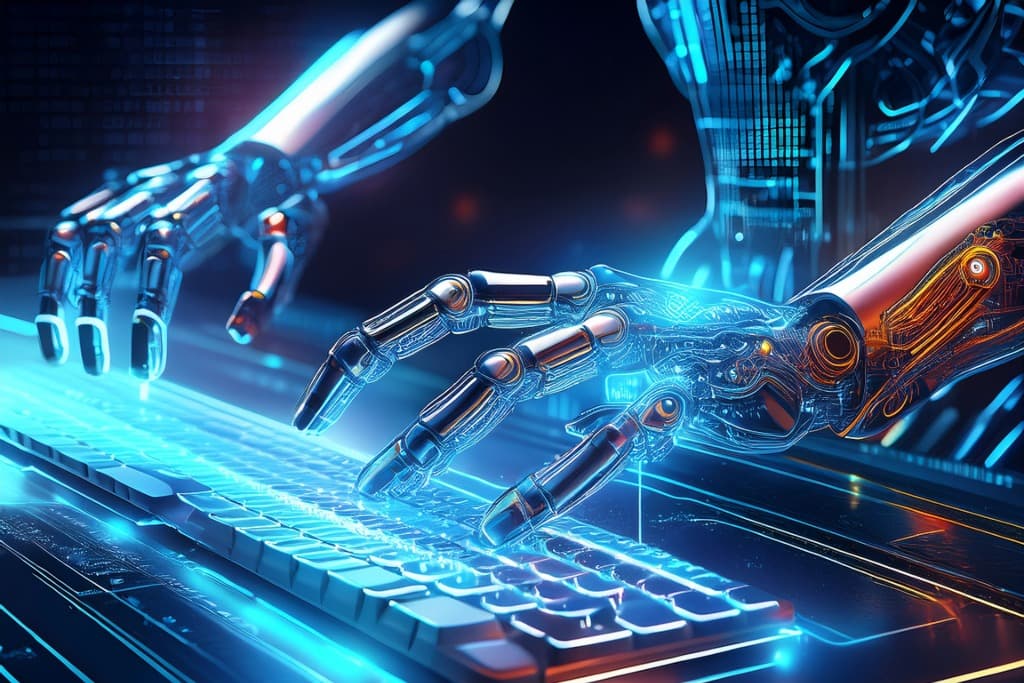
The future of coding isn't just about humans writing code faster; it's about AI generating entire applications from a simple conversation.
From Co-Pilot to Architect
We've become comfortable with AI as a co-pilot, suggesting the next line of code or completing a function. But the latest generation of AI tools is making a monumental leap from assistant to architect. Instead of helping us write code line by line, they are beginning to understand intent.
Developers can now use natural language to describe an application's features, user interface, and data requirements. The AI then acts as a full-stack developer, generating the front-end components, back-end logic, and database schemas required to bring the idea to life. Projects like GPT-Engineer and platforms like Debuild are prime examples, capable of scaffolding entire, functional codebases from a series of prompts.
How It Works: From Prompt to Production-Ready Code
This new paradigm is powered by advanced Large Language Models (LLMs) trained on vast datasets of code, documentation, and human language. They have learned the patterns, structures, and logic that underpin software development.
The process looks something like this:
- The Prompt: A developer or product owner provides a high-level description: "I need a web app for a local library. It should allow users to search for books, see their availability, and place a hold."
- Clarification: The AI might ask follow-up questions to refine the requirements: "What fields should the 'book' database contain? Title, author, ISBN? Should users need to log in to place a hold?"
- Generation: The AI generates the complete file structure and code—HTML, CSS, JavaScript (perhaps using a framework like React), and a back-end language like Python or Node.js with the necessary API endpoints and database logic.
- Iteration: The developer can then review the generated code and ask for changes: "Add a rating system for the books," and the AI will modify the codebase accordingly.
"The most valuable developers of the future won't be the fastest coders. They'll be the best communicators—the ones who can translate a complex human need into a clear, precise prompt for an AI."
The New Job Description for Developers
If AI can write the code, what's left for human developers? The answer is: a lot. The role is simply evolving from a "coder" to a "systems architect" and "AI orchestrator." The most valuable skills are shifting towards:
- Problem Decomposition: Breaking down complex business needs into clear, unambiguous prompts that an AI can understand.
- System Design: Making high-level architectural decisions about which technologies to use and how different services should interact.
- Critical Review & Security: Auditing AI-generated code for security vulnerabilities, performance bottlenecks, and logical errors that the AI might miss.
- Creative Problem-Solving: Tackling the novel, "out-of-the-box" challenges that require true human ingenuity.
Developers are no longer just bricklayers; they are the architects who design the blueprint and supervise the automated construction crew.
Conclusion: A New Partnership in Creation
The idea of software that writes itself isn't about replacing humans. It's about augmenting them. This technology is set to unleash a wave of innovation by drastically lowering the barrier to creating software. It allows for rapid prototyping, faster iteration, and frees up human developers to focus on the most challenging and creative aspects of their work.
The future of coding is a collaborative partnership between human creativity and artificial intelligence. We provide the vision, and the AI helps us build it at a speed we could only dream of a few years ago. The future is here, and it's writing itself into existence.